
A Family Resemblance

By Bobby Gilles (MANT Northern Seminary) is a pastor and songwriter in Indiana. He and his wife Kristen have two daughters and three sons. Connect with him at bobbygilles.substack.com, where he helps people envision a blessed alliance of women and men, from all tribes and tongues, mutually serving Jesus. Find him @bobbygilles on Threads, Bluesky, Facebook, and Instagram.

Photo by Rajiv Perera on Unsplash
I have spent most of my life in conservative evangelical spaces where they don’t talk much about Jesus's mother. When they do, it sounds like God used Mary as an incubator for Jesus, but little else. Yet Mary is one of many amazing women in the Bible, church history, and my life who changed my mind about how God sees women and how the church should see them. Mary challenged my perspective by being the first and perhaps best teacher of her holy son, stamping an indelible mark on the New Testament and the kind of faith community Jesus would form.
Mary provided moral instruction for the Messiah. This may seem a bold claim. Did Jewish mothers do this in the Second Temple period? Did the God-man need instruction? Do we have evidence of Mary’s influence upon Jesus? The answers are “yes,” “yes,” and “Not only Jesus, but his epistle-writing brother James, too.”
First, every line of Mary’s song, the Magnificat (Luke 1:46-55), quotes or alludes to various passages in the Hebrew Scriptures. Mary was almost certainly illiterate but she had heard and internalized so much scripture that she could recite it and understand it -- certainly enough to compose the Magnificat, and enough that when Gabriel told her she would bear the “Son of the Most High” whose “kingdom would never end,” she didn’t ask “What does that mean?” but only “How will this be?” (Luke 1:32-34).
Mary stood in a line of mothers who raised their children to know scripture. We see women like this in Timothy’s family tree: “I am reminded of your sincere faith, which first lived in your grandmother Lois and in your mother Eunice and, I am persuaded, now lives in you also” (2 Tim. 1:5). The letter goes on to say, “But as for you, continue in what you have learned and have become convinced of, because you know those from whom you learned it, and how from infancy you have known the Holy Scriptures, which are able to make you wise for salvation through faith in Christ Jesus” (2 Tim. 3:14-15). We learn nothing of Timothy’s father, but the kid will be all right – Mama Eunice and Nana Lois made sure of it.
We see a similar dynamic in the third or second century B.C.E. Jewish book Tobit, who credits his grandmother with teaching him Torah. Tobit writes about tithing and sharing meals with orphans, widows, and Jewish converts “according to the ordinance decreed concerning it in the law of Moses and according to the instructions of Deborah, the mother of my father Tobiel, for my father had died and left me an orphan” (Tobit 1:8).
Second, we may be tempted to think that the “human” side of Jesus needed to grow taller, but the “divine” side needed no instruction. This is similar to the “God in a bod” heresy, Apollinarianism, which speculated that Christ was human on the outside and God on the inside. The great ecumenical councils of the church answered this and other early Christological heresies that either taught the Son of God wasn’t fully divine or human, or that his divinity obliterated his humanity.
Jesus “grew in wisdom and stature” (Luke 2:52), passing through the stages of human development. The brain of Jesus had to grow as ours do, receiving food, water, information, and other stimuli. He had to grow in self-awareness. For this reason, the triune God chose Mary, who had “found favor” with God (Luke 1:30), and Joseph, who was “faithful to the law” (Matt. 1:19). Their home would provide Jesus with the instruction he needed. “He had to be made like them, fully human in every way, in order that he might become a merciful and faithful high priest” (Heb. 2:17).
Since Mary became a single mom sometime after Jesus’s twelfth year, her role is even more critical. And since the Gospels give us some of Mary’s words but none of Joseph’s, we can only track how Mary’s words shaped the mind of Jesus. Because Jesus is fully human, Mary taught him the things Jewish children learned from their mothers, if not more. Mary educated Jesus alongside his sisters and brothers, watching him grow in wisdom before and after Joseph’s disappearance from the historical record.
Finally, Mary's influence upon her son is undeniable when we look at the words and themes of the Magnificat next to the words of Jesus, like his vow to preach good news to the poor and freedom to the prisoners (Luke 4:18-19), his claim that those who exalt themselves would be humbled, but those who humbled themselves would be exalted (14:11; 18:14), and warnings of judgment to those who trust in wealth (8:14; 12:21; 16:19-31; 18:23-25). But perhaps we see Mary’s influence most clearly in the Beatitudes and Woes (Luke 6:20-25):
Mary says, “For he has been mindful of the humble state of his servant. From now on all generations will call me blessed.” Jesus affirms, “Blessed are you who are poor, for yours is the kingdom of God.”
Mary shouts, “He has filled the hungry with good things but has sent the rich away empty.” Jesus echoes, “Blessed are you who hunger now for you will be satisfied … But woe to you who are rich, for you have already received your comfort.”
Mary sings, “His mercy extends to those who fear him, from generation to generation,” and Jesus harmonizes, “Rejoice in that day and leap for joy, because great is your reward in heaven. For that is how their ancestors treated the prophets.”
Someone else learned these lessons, too: Mary’s son James. His letter echoes his mother’s song and his brother’s teaching more than any other epistle. Consider the consistency of themes:
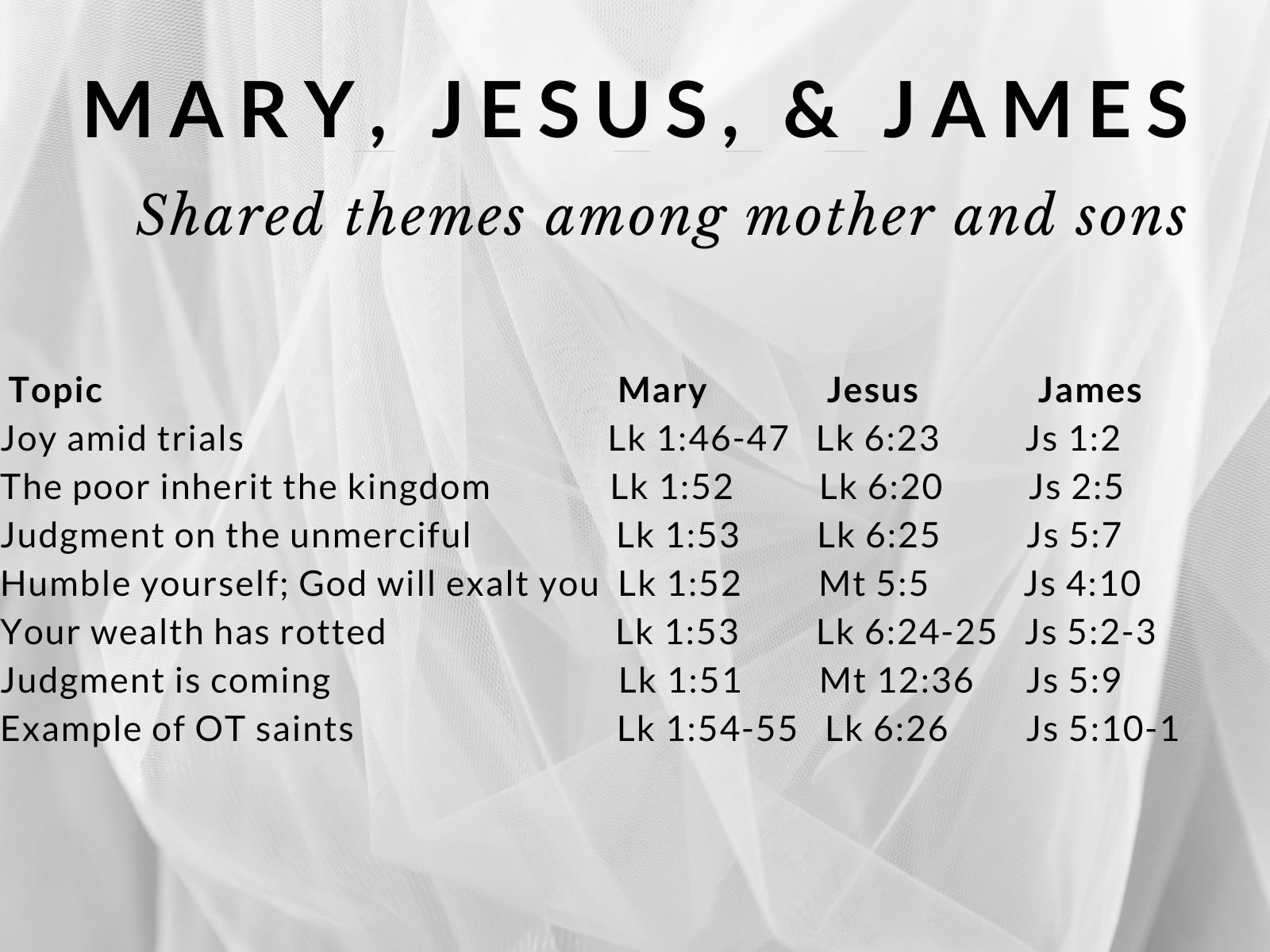
Even with just ten verses from Mary and one short letter by James to analyze, we see the family resemblance. We could draw similarities from Paul's themes across his whole corpus, but we would be drawing from a much larger sample size amid many more themes. The similarity of themes between Mary, Jesus, and James (compared with the proportionally lesser density of these themes in Paul and other epistle writers) shows the influence of this mother upon her sons. If you had been an acquaintance of Mary in her young adult life and stumbled upon Jesus and James decades later, you wouldn’t have had to converse with them long before you knew whose children they were. They were Mary’s boys.
Jesus learned from Mary. Even after the incident in the Temple when he felt he “must be about his father’s business,” he accepted Mary’s rebuke and submitted himself to his parents’ instruction (Luke 2:41-52). Part of learning to be like Jesus, then, is to accept truthful teachings from women. I have learned and put this into practice in my own life, and it has made me stronger, happier, and better able to minister to men and women alike. The daughters of Mary are teaching today in church families around the world. Will you listen?
Thank you for today’s topic.
God has so much to teach us through Mary. And perhaps as much through WHO SHE IS, as I have tried to demonstrate, as through her words.
We see her symbolized/anticipated in Eve.
In Noah's ark, bearing the seed of the renewed world.
In the basket carrying the Moses above the waters of the Nile, where Pharaoh drowned the baby boys.
In the ark of the covenant, overshadowed by the cherubim.
In the pot inside the ark, containing heaven-given bread.
She symbolizes the earth, receiving the saving seed of heaven.
Her silent pondering of words and events, gestating....