
Commonplace Book

Storing your favorite quotations is a discipline. Only fifteen years or so ago I began to record mine in a program written by the techno-skilled husband of a graduate assistant of mine. I asked her to type in quotations from books I had marked — and I have been marking my books for quotations for, well, thirty years. But memory is what memory does, and it doesn’t always do memory. Memory sometimes does forgetting.

Swiped from here
I was aware of commonplace books because of the essayists I have read — and I have read oodles of them. But I relied on my memory, or my leafing through a book to find what I thought was from that author. Alas, not always by that author and not always find-able. When it was both, it could be a magical quotation by the right author at the right time.
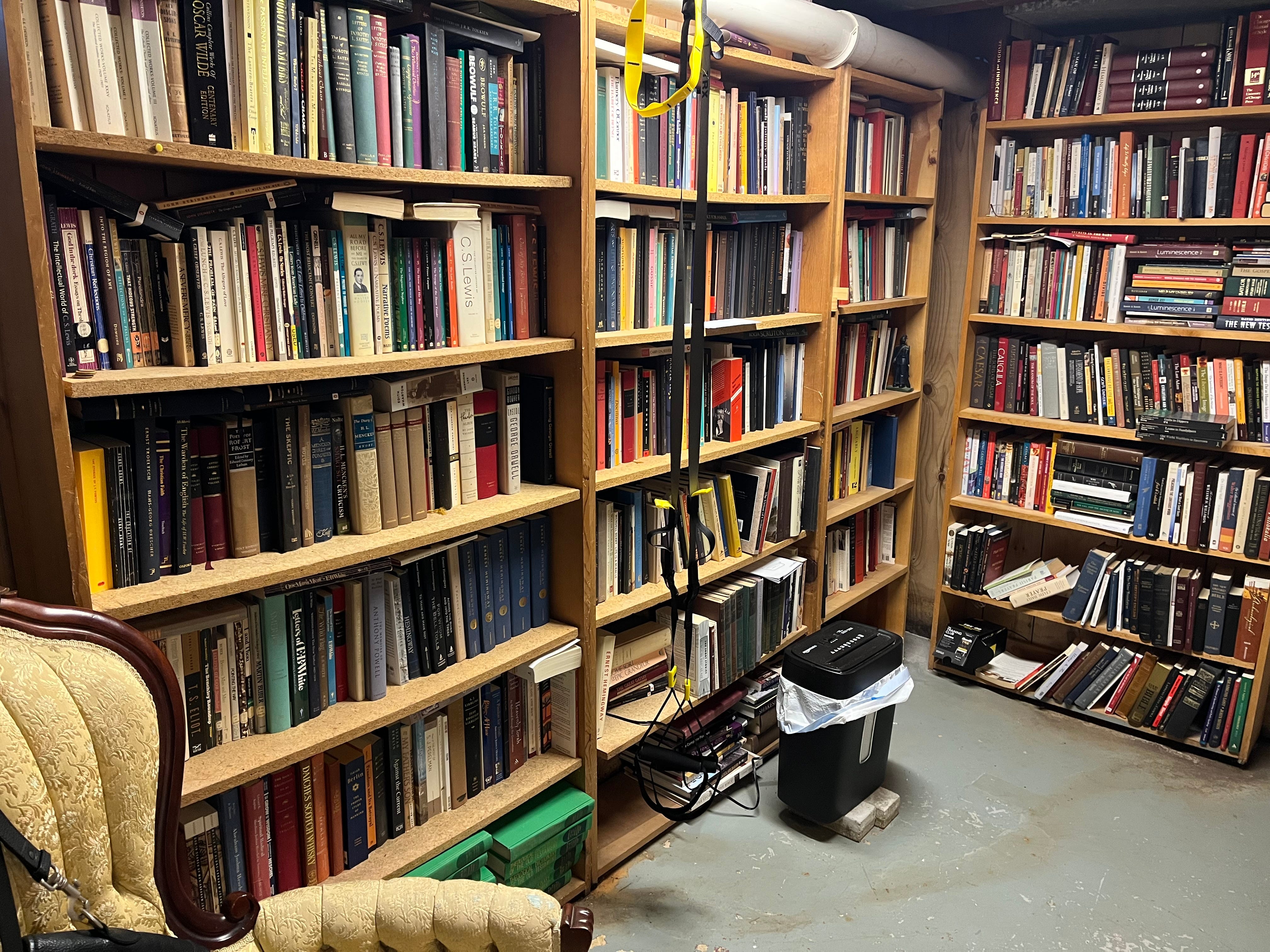
Here are some of the shelves in my library of "Writers” — and along with them some books for which I have run out of space. (Which has become a bit of a challenge.)
Which brings me to this: How do you store quotations? My style now is to record them in a massive MSWord file called, you guessed it, “Commonplace.” To use of these quotations in a sermon, lecture, book, or essay, I will use the page number to make sure I’ve got it right. I will read a page or two to make sure I’ve understood it, and then I will drop the quotation.
As you can see, I can search by topic as well (Writing, prose — in the first citation). There are misspelled words, which I have left because, well, someone did not spell them when they typed this in. I can easily correct the misspellings when I use the quotation.
Here is a page or two from Gordon Bowker’s biography of George Orwell.
Gordon Bowker
Inside George Orwell (pg. xvi)
Transpicuous Prose
While many writers and poets of Orwell’s generation chose to express their inner lives through the seductive fog of poetry or the jargon of political sects, he chose rather the window pane of transpicuous prose.
Writing; Prose -- Gordon Bowker
Inside George Orwell (pg. 17)
Presence of the past
The past is a curious thing. It’s with you all the time,I suppose an hour never passes without your thinking of things that happened ten or twenty years ago, and yet most of the time it’s got no reality, it’s just a set of facts that you’ve learned, like a lot of stuff in a history book.
History; past -- Gordon Bowker
Inside George Orwell (pg. 24)
Removed Soul
“I thought of a rather cruel trick I once played on a wasp. He was sucking jam on my plate, and I cut him in half. He paid no merely went on with his meal, while a tiny stream of jam trickled out of his severed esophagus. Only when he tried to fly away did he grasp the dreadful thing that had happened to him.It is the same with modern man. The thing that has been cut away is his soul, and there was a period - twenty years, perhaps - during which he did not notice it.” - Malcolm Muggeridge in The Thirties
Soul; Modern Man; Unnoticed -- Gordon Bowker
Inside George Orwell (pg. 32)
Social Contradiction
Orwell reflected wryly that he possessed none of these qualities and, in any case, saw a contradiction at the heart of the system - ‘Broadly, you were taught to be a good Christian and a social success, which is impossible.’
Success; Contradiction; Christian life -- Gordon Bowker
Inside George Orwell (pg. 54)
Library
Blair’s Eton contemporaries included an excess of literary talent - not just Connolly and Runciman, but Anthony Powell, John Lehmann, Henry Green, Harold Acton and Ian and Peter Fleming. One of his teachers was Aldous Huxley, and the newly appointed Provost was M. R. (’Monty’) James, the distinguished classicist, ghost story-writer and translator of fairy stories.
library; Authors; company -- Gordon Bowker
Inside George Orwell (pg. 77)
Oppression by Police
As the ship docked, he was horrified by the sight of a white policeman kicking a coolie without a word of protest from any of the ship’s passengers.’Here were ordinary, decent, middling people: he wrote,’people with incomes of about 500 a year, watching the scene with no emotion whatever except a mild approval. They were white, and the coolie was black. In other words he was sub-human, a different kind of animal.’ This event must have struck him as ominous, a preview of a far more oppressive system than the English class system onboard ship. Now he was heading in all innocence to become part of such a regime himself.What is more, the oppressor he had observed was a policeman, filling exactly the role he was himself engaged to fill in Burma.
Prejudice; Racism; Oppression -- Gordon Bowker
Inside George Orwell (pg. 87)
Inner Turmoil
At some moment he stood back and asked, ‘What am I doing here?’ The role and the uniform had taken him over and he hated what he had become. Once he had taken that step he was quite lost to British imperialism.
Confusion; change -- Gordon Bowker
Inside George Orwell (pg. 92)
Freedom except in speech
It is a world in which . . . free speech is unthinkable. All other kinds of freedom are permitted. You are free to be a drunkard, an idler, a coward, a backbiter, a fornicator; but you are not free to think for yourself . . .
Free Speech; Freedom; Sin -- Gordon Bowker
Inside George Orwell (pg. 96)
Success
To do this he felt he had to reject the idea of ‘success in life’ as ‘spiritually ugly,’ a species of bullying: and embrace failure.
Success; Spirituality -- Gordon Bowker
Inside George Orwell (pg. 129)
Disguise
In Trafalgar Square his disguise almost slipped when he began reading a French edition of Balzac’s Eugenie Grandet which he happened to have taken along; however, the other tramps merely concluded that it must be a dirty book. Conceal his class origins as he might, he could “I never shed his literary self,” which remained alert, consciously transforming squalid experience into literature.
Disguise; Book; Confusion -- Gordon Bowker
Inside George Orwell (pg. 168)
Pseudonym
He had, on his own admission, always had a secret fictional inner life, and Orwell was no doubt the public expression of that subjective narrator. So there, in between the lines, can be glimpsed the evolving consciousness of both the man and the man of letters. There were other personae, of course, in his complex make-up ex-policeman, man among down-and-outs, importunate lover, patron of brothels, friend of curates, rectors and clergymen’s daughters, drunken writer on a congenial pub-crawl, naturalist, gardener, and failed son of Richard Blair.
Pseudonym; identity -- Gordon Bowker
Inside George Orwell (pg. 206)
Incapable of danger
The first shot fired was a dud. A bad omen, thought Orwell. He was made capo (or corporal), and although the men would not obey orders without a discussion, and were so incapable as to be positively dangerous, he grew to admire their peculiar indiscipline and youthful bravado, even while wondering how the war could be won with such a disorganized rabble.
Danger; Fear; bravado -- Gordon Bowker
Inside George Orwell (pg. 419)
Biography
... biography begins at the moment of death... Biography is a means of resurrecting the dead.
Biography -- Gordon Bowker
Stinky book
is a book that stinks: he wrote. ‘If it were possible for a book to give a physical stink off its pages, this one would . . . He is as antisocial as a flea.
Book; Writing; challenge -- Gordon Bowker
Inside George Orwell (pg. 427)
Moral Behavior in Godless Age
What constitutes moral behavior in a godless age? Can individual freedom survive in the face of collective power? How can we protect ourselves from unscrupulous manipulators of language? How can social democracy be achieved and defended against unprincipled totalitarians on the one hand and unprincipled capitalists on the other? How is the unbottled genie of science to be controlled?
morality; Freedom; society -- Gordon Bowker
I use Joplin, an open source app similar to Evernote. It’s free with unlimited entries, and can be organized into separate “Notebooks” (files). I’ve got a Notebook for Quotes and a Notebook for Illustrations and a Notebook for a book idea I’m working on. I can add multiple Tags to each entry, like “Funny” or “Syncretism” or “Rome.” This makes searching for anecdotes and quotes on a particular topic quite easy. I always document my quotes by author, title and page number for easy citation later.
Great quotations from the bio of Orwell!
Small note: did you know that the late, lamented Madeleine L'Engle titled a book based on the Muggeridge quotation? "A Severed Wasp," in which she explores the double entendre in "wasp" (taken as an acronym!). It's a great novel.