
Four Decades On

The first seminary class I taught was a Greek Exegesis class at TEDS, and it was a two-semester course (Exegesis I & II). Fall 1980-Winter 1981. The seminary was kind enough to give me a small office next to the water fountain and bathrooms in the Peterson wing. I don’t recall the days for teaching, but I’m thinking it was Tuesday and Thursday. I still have a picture of the class. Every now and then I open my Moleskine, and there the students are! I’m glad I wrote their names on the back. Every now and then, mostly then, I get a note from one of them. They are, I’m sure, as surprised of me as I am of them.
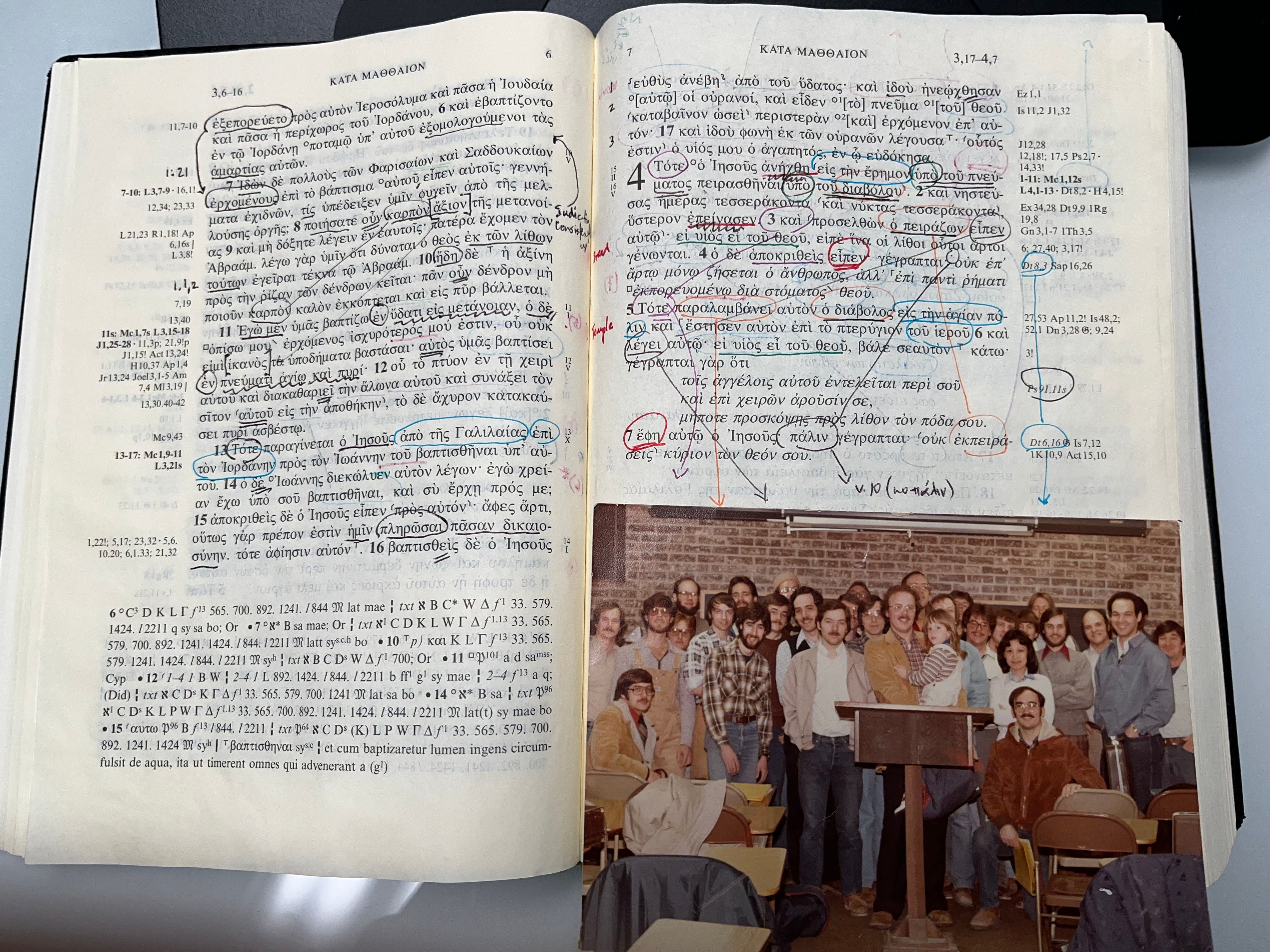
Things have sure changed. Speaking of change, that Greek NT was not the one I was using.
I was “rocking” a plaid long sleeve shirt with a collared T-shirt under it; a corduroy coat with elbow patches (of course); brown slacks and some tan leather shoes with gum rubber soles. I was holding on my hip my young daughter who came to class that day with me, and sat next to the only woman in the class, Vivien Lai. One of the students in the front row reads this Substack, so speak up Dan if you read this.
As I said, things have changed. Take attire. Professors at the time, and I’m going on what professors wore at the academic meetings, mostly wore dress slacks, coat and tie. When I returned from PhD work, and before I had graduated (1986), I began teaching at TEDS again. This time full-time, with advisees and expectations to attend faculty meetings. It was a heady time as I both anticipated finishing and wondering where we’d have to move to get a full-time teaching post. It was much easier then than it is now. As it turned out, TEDS offered me–read this slowly–Wayne Grudem’s NT post because he had moved over to ST. So, I began teaching on a tenure track, if my memory is straight (and crooked on this one won’t matter), in 1985. Every time I attend IBR or SBL (and ETS meets before those two events) I see lots of young folks with eager faces hoping, I assume without asking, they will land a post. As I said, it’s not easy today. The lines are long with already-PhDs looking for a post.
Teaching is not what it was either. I taught in a classroom filled with mostly full-time students who planned on pastoring or, in some cases, hoped to do a PhD and do what I (at that time) hoped I would get to do. And I did. Teaching was all in-person, and we had “no such term and no such situation” (sounds like Elvis). I got to know my students names and sometimes I met their spouse. We had lunches or coffee together at times. Or ice cream cones if they dared me on knowing what names the initials of NT scholars stood for (C.F.D. Moule, C.E.B. Cranfield, F.F. Bruce). They stopped by my office at Office Hours and at non-Office Hours to chat, to pray, to ask questions, to figure where the Lord was leading them. It was all so physical. I can see and smell and feel places.
We taught with overhead projectors on which I diagrammed Greek sentences. I dished out handouts like candy. Exegesis classes were dialogical as students translated and I asked questions about parsing and syntax. Sometimes the Greek sentence diagram flowed into a sermon outline (not a very good one, but, hey, I was a professor and not a pastor or preacher). Students read advanced commentaries, like J.B. Lightfoot, H.D. Betz, F.F. Bruce–those who know know I’m talking Galatians. Students nearly all knew one another in those classes, though the lecture classes (Synoptic Gospels) were too big (sometimes over 100) for everyone to know everyone. I’m glad to say I learned all their names at that time. (I would fail at that these days.) Students commuted, mostly from the northern suburbs. Some worked at UPS-like facilities. Others were part-time pastors, or full-time pastors with classes jammed into their schedule. Many were married, and some were looking to get married. In the years I was at TEDS, which until the mid-90s, some were looking for partners but the demographics were lopsided toward men. I’d say 90%. I’m guessing.
We all typed on either manual or electric typewriters until the mid to late 80s. IBM Selectrics, which the great historian Peter Brown called golf ball typewriters, were the reach of technology at one time. We had secretaries who turned our scribbles into neat type, and then we read them over and they typed them into a clean copy. Students typed papers and turned them in mostly on time. Students apologized for a late paper. Some professors took points off for typos–this was before being able to blame it on autocorrect–and papers were not by word count. They were by page count. Fonts were all about the same. Double spacing was the only way that I recall. We graded on that paper and passed the papers back in class, told them to come by the office or the secretary to pick them up, or put them outside our door for students to pick up. No one cared that some students might get snoopy and peer into the grades of others. We turned in grades on paper before the days when we turned them in on the computer. I don’t believe that happened until the early 2000s.
Students went to the library to do research. They gathered books at a carrel or at a table, and went to work. They checked out books to take home and worked from home. Or, they decided to build their own library and began making visits to Grand Rapids and to used bookstores in Chicagoland, and by the second or third year could skip the library for at least some of their research. Students asked professors what to read; students asked students about other professors to take; students asked one another about how to write a paper for that professor; and students relied on librarians to help them get started in their research.
Those were the days. They’re mostly gone.
Professors today wear Air Jordans at times. I’ve done it. Mostly for a stunt. I can’t imagine my professors wearing tennis shoes. I teach at times these days in blue jeans.
Young professors today sometimes have to teach all, or at least most, of their courses online. On our walk the other day Kris exclaimed, Who’d want to do that! I had brought up one of my former students who took a post in the Midwest and after a year or two moved on because, as I recall, she didn’t want to do all the online courses. Teaching, to quote a memorable baseball book, is whole different ball game. Students are online; students turn in digital copies; professors read digital copies; professors mark digital copies; professors turn in digital grades; students receive digital feedback and grades. Some professors never so much as shake hands with students, and many students never meet their professors. I know a professor who couldn’t take the disembodied classroom and quit. Up and gone. I would not teach if the entire class was online, so my days are numbered. I’m writing this during a week when on Saturday I will be teaching online for a number of hours and I dread it. It’s only do-able because I have been a week-long intensive with these students.
Students today use AI and consider it research. It isn’t. AI’s doing “research” and the student expects AI to do more than it can do. Students today tend to think everything is online and if it isn’t, it doesn’t matter. (It does.) Some students have “libraries” that are almost entirely digital. For some the only Bible they have is online, and they use a phone for Bible reading. Students today can amass more sources in 20 seconds than we could–back in the day–in 200 minutes by combing through shelves and the manual card catalog and asking the librarian where section 226.2 is. (Yes, Dewey Decimal was serious business.) Students have access to grammar checks and spelling checks in their MS Word file. From what I hear, they can submit their paper to writing programs that will adjust and fix and improve their prose. Whether they look at it and learn from it or not. It’s a whole lot faster than looking up Strunk and White. I hope they learn from the automated fixers.
It took professors a week or two, and in some cases an eternity, to get papers graded. Schools can now monitor professors on when papers are due and how many papers are stuck in their system and how many aren’t graded and how many grades are not turned in and when they are due. This is all to the better for students.
I, for one, am not persuaded by the digital systems at work today. The best classes are when we gather together, around a text or topic, and the computers and phones are absent, and we talk to one another. And say goodbye. Some students shake hands, some hug, and some leave the class period with tears in their eyes. Some professors, too.
If I had life to do over again I would have been one of your students. Did my doctoral study in Sociology and labored at a state institution. Was the faculty sponsor for InterVarsity for 24 years and that led me to go to work for them for 15 years as my career climaxed. All of my theological training/experience was self guided and self taught. Retired now for 13 years, most of my continued study/reading are on spiritual and church issues. Enjoyed reading this a lot as my career spanned the times from a manual typewriter to very fast computers.
I’m thankful for the opportunity that online classes affords, but you can’t beat those in-person, intensive classes. I’m glad I got to have two of them with you.