
Getting Lost in a Texbook


When I got to college, a Christian college, one of my first textbooks was Robert Gundry’s Survey of the New Testament, a 1970 publication. (It was 1972 when it was assigned for my class.) I was already a Bible student of sorts and his explanations of what the text was saying at the literal level were very helpful. We were supposed to read the whole New Testament and then Gundry. Some of my classmates confessed they didn’t read the NT because they found his summaries good enough. He and his publisher (Zondervan) began producing new editions, and it is in the 5th edition now (1970, 1981, 1994, 2003, 2012). So every ten years or so a new edition comes out. The publisher now has a “Textbookplus” digital resource. Some publishers are good at textbooks, and Zondervan is one of them.
So, too, is Baker Academic, and a recent textbook publication is the reason for this newsletter today. Ruth Anne Reese and Madison N. Pierce, with Baker, have produced a beautiful new volume in the “Reading Christian Scripture” series. There are digital resources, too: “Textbook eSources.” Their new book has this title: Reading the Later New Testament as Christian Scripture: A Literary, Canonical, and Theological Introduction (BakerAcademic, 2026). Reese teaches at Asbury Theological Seminary and Pierce is at the University of St Andrews. (Think golf courses.) Reese has commentaries on James and 1 Peter, while Pierce has a marvelous volume on Hebrews. I’m not a little happy that this introduction is by two women scholars, and the only endorsement on the back cover is by Amy Peeler, who is herself a specialist on Hebrews. Madison Pierce and Amy Peeler are two of the finest scholars today on Hebrews. Madison is Reformed interpreter and Ruth Anne is a Methodist. Their chps are from their point of view, with suggestions from the other.
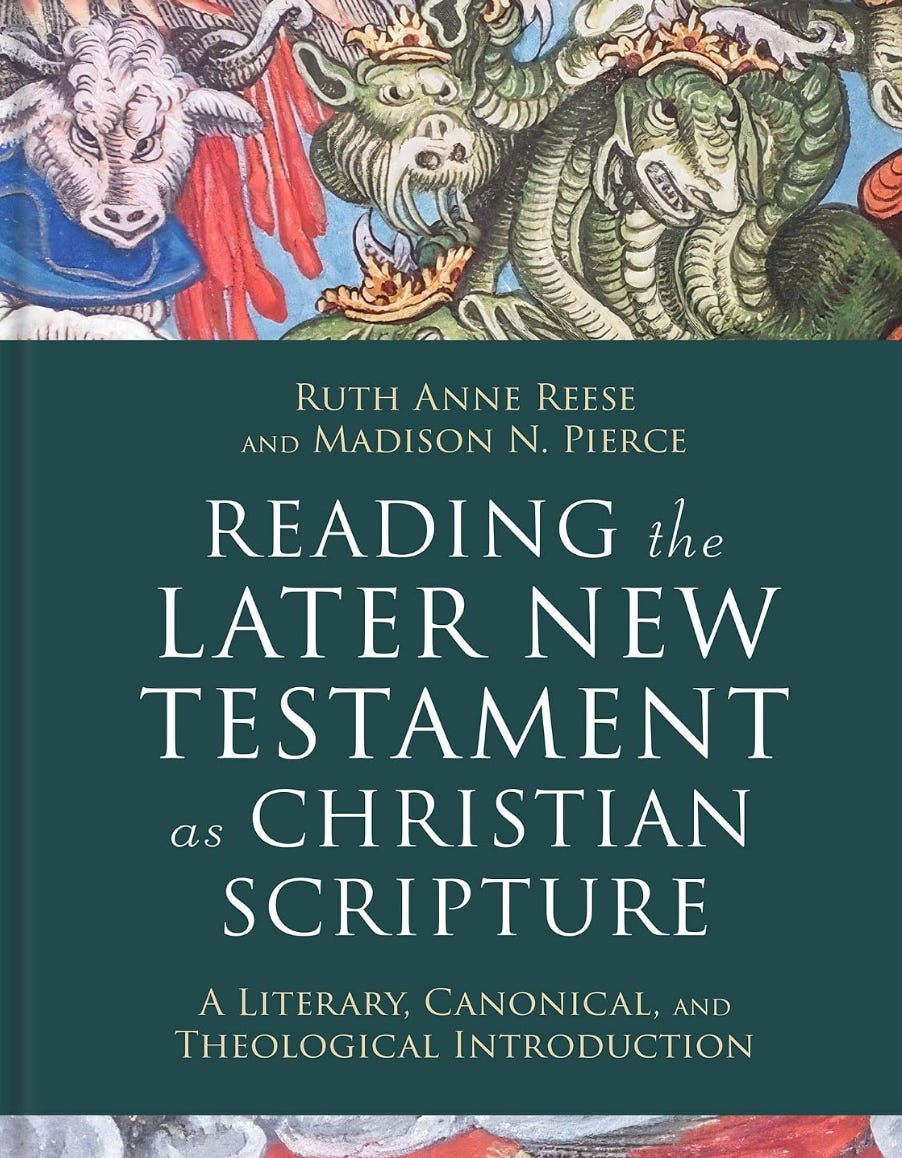
We need introductions. By “we” I mean We professors, we pastors, we students, we seminary students, we serious Bible readers. Many have a one-volume NT introduction, like the one by Joel Green, Marianne Meye Thompson, and David Downs. But BakerAcademic’s is not quite the same because the distinctive of this book and series is reading the books as Christian scripture with the approaches of literary, canonical, and theological. Plus, many of us have taught a NT curriculum in which there are two, and often three, classes: Jesus and Gospels, Acts and Paul, and what a former set of students called “The Leftovers.” (That’s from my TEDS days.)
Publishers know that introductions can be a dime-a-dozen. I only keep two full NT intros on my shelves because they go over the same stuff. It’s like coffee. One cup is not enough. I digress. I don’t need ten NT intros explaining the authorship of Hebrews. What BakerAcademic has done is to create a broader experience for readers of the “later” books of the NT, and by “later” they mean in the order of NT books and sometimes dates. These are, as they say, the “non-Gospel, non-Pauline texts.” These books are sometimes ignored by well-meaning Christians. They see them as “often forgotten, often confusing, always helpful.”
Each of the Later NT books (IVP Academic has a dictionary on with that kind of title) is treated according to (1) historical matters, (2) literary notes, (3) theological issues, (4) canonical connections, and (5) reception history. This is a pleasing-to-the-eye book; not too many words on a page; lots of color and sidebars and graphs and charts and photographs. It’s easy to get lost skimming through this book. I know, I did.
While Christian colleges and even seminaries are declining authors and publishers are producing better and better introductions and scholarship. This would have been an amazing book for that NT class I took in the early 70s, and it would be the same for seminary classes on the “leftovers.”
I am in receipt of said book, and it is beautiful. Thank you for the recommendation!
Sounds like a must read, even for a 77 yr old retired pastor! Thank you.