
Meanderings, 2 August 2025

We enjoyed last weekend with Amanda Clark and the Gertie Girls in Warsaw IN, and then Kris and I drove north into N Michigan to Charlevoix for a few days of relaxation, walking, driving through the Leelenau peninsula, and, ahem, tasting some Kilwins ice cream. IYKYK. When we’re in N Michigan, I try to read a few short stories by Hemingway. This time we visited Walloon Lake, which is where his family owned a summer cottage.
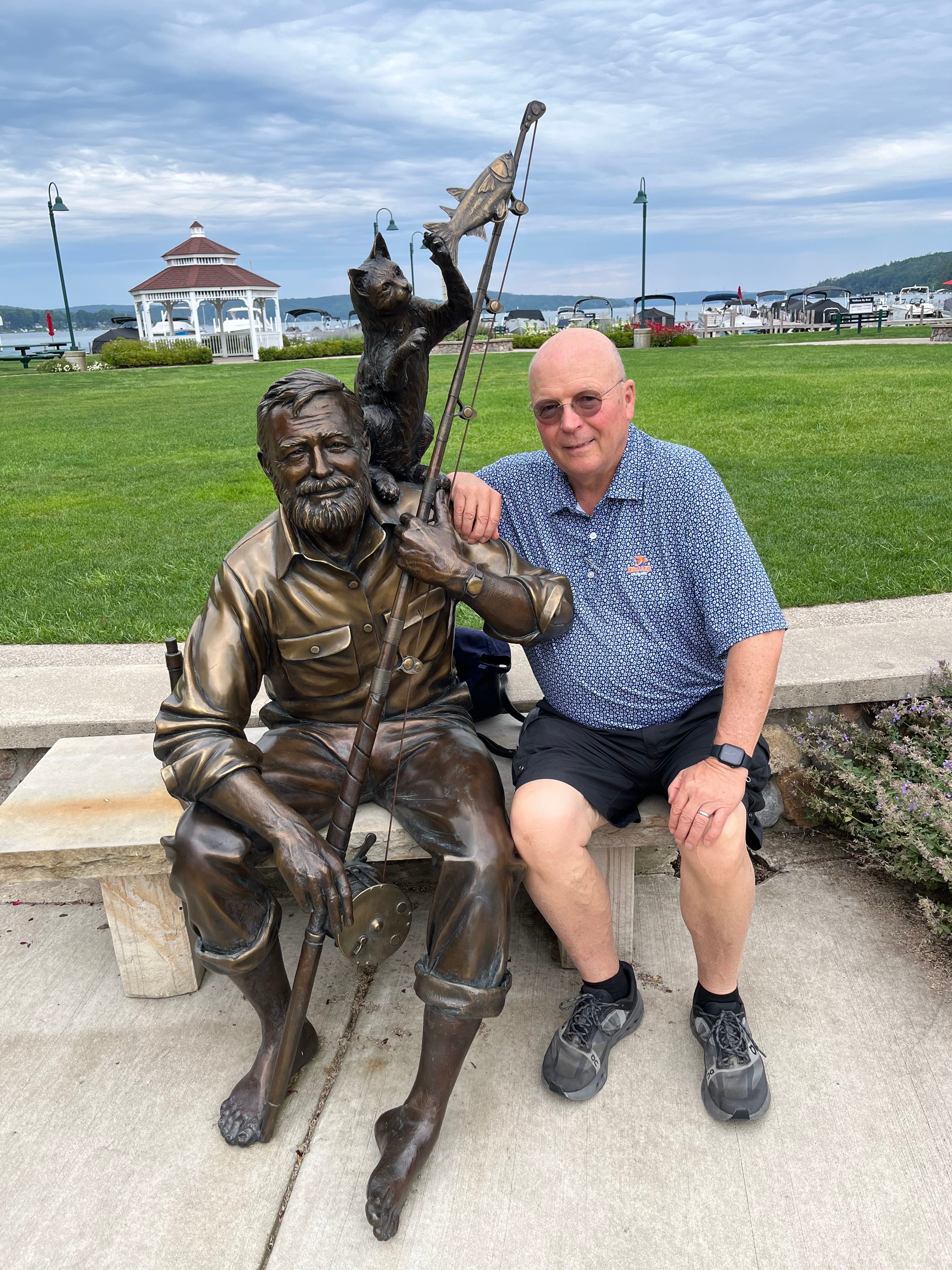
Credit for Photo: Kris
Cradles to Crayons, yay! 36,000!!!!
CHICAGO — Hundreds of corporate volunteers gathered on the floor at Wintrust Arena on Wednesday to pack thousands of backpacks for Chicagoland kids in need as part of an annual initiative.
Cradles to Crayons held its Backpack-A-Thon, the signature event in its Ready for Learning initiative. Volunteers worked to fill 36,000 backpacks with new school supplies in just over two hours Wednesday.
“Each year that we do this, it reminds us what can be achieved when a city comes together and unites,” Dawn Melchiorre, Executive Director of Cradles to Crayons, said during Wednesday’s event.
“Volunteers from every corner of our city and suburbs, partners both old and new, all working toward one goal — ensuring that every child in the Chicagoland area begins school with the confidence, hope and joy that they need to make sure that they have a successful school year.”
There’s also some fun competition among the volunteers to see who can fill the most backpacks.
“We have so much fun coming together,” Justin Casazzn, a volunteer, said. “It’s one of those events that we can all feel good about ourselves, feel good about what we’re doing, but also just have a lot of fun and build that team spirit, that camaraderie that we love.”
Since 2016, Cradles to Crayons has provided over 100,000 Chicago Public Schools students with 1.2 million school supplies. The organization also helps with other necessities for children in Chicagoland, including new and gently-used clothes for children experiencing homelessness or low-income situations.
The SBC just doesn’t want someone leading ERLC who doesn’t align with Project 25, which is simply not Reagan politics. Nor is it conservative.
Brent Leatherwood, president of the Southern Baptist Convention’s Ethics and Religious Liberty Commission, resigned on Thursday (July 31), saying it was time for him to move on.
“After nearly four years leading this institution, it is time to close this chapter of my life,” Leatherwood said in a press release announcing his departure. “It has been an honor to guide this Baptist organization in a way that has honored the Lord, served the churches of our Convention, and made this fallen world a little better.”
The move comes after a tumultuous year for the ERLC, the public policy arm of the nation’s largest Protestant denomination. In summer 2024, after an attempt to abolish the agency failed during the SBC’s annual meeting, the former chair of the ERLC’s board announced that Leatherwood had been fired — only to be overruled hours later by the rest of the board.
Last month, nearly half (43%) of the delegates to the SBC’s annual meeting voted to shut the ERLC down — the fourth attempt to defund or disband the agency in recent years.
Leatherwood, who took office in 2022 after serving as interim leader for a year, is the third ERLC president in a row to step down under fire. Like his predecessor Russell Moore, who stepped down in 2021, Leatherwood was criticized for not being in line with President Donald Trump’s MAGA agenda. Critics also say the agency has been out of touch with local churches and has become too liberal on issues such as immigration. Those critics had called for Leatherwood’s resignation.
Sad news about Spurgeon’s College closing.
Founded in 1856 by Charles Haddon Spurgeon, the College has faithfully served for 169 years, training thousands of men and women for Christian mission, ministry, and leadership in the contemporary world. Each graduate stands as a testament to the enduring legacy of our founder and the College’s commitment to theological education and Christian service.
God has blessed the College in amazing ways through our long history, and we encourage everyone at this challenging time to pray for his guidance so that men and women continue to be prepared for Christian ministry. It is with heavy hearts that we share this news, and we express our deep gratitude to all who have supported Spurgeon’s College throughout its history.
Anglican rites, rituals, and practices — thinking about 19th Century polemics against what is so “typical” today —
Though liturgical, the liberal theology of the Episcopal Church discouraged many evangelicals from considering the Anglican tradition. Recently, the creation of the more conservative Anglican Church in North America in 2010 has provided an attractive option. This new-found love for all things liturgical may overlook, however, an important question: how much of what today's pilgrims associate with Anglicanism is actually Anglican? The answer may surprise many of the faithful traveling on the Canterbury Trail. Careful historical investigation paints a different picture from what many have come to assume.
One simple way to illuminate and clarify the historical reality is to revisit a nineteenth-century attempt to regulate worship in the Protestant Episcopal Church. In 1871, General Convention heard and debated a special bishops’ committee report on a host of controversial practices. The canons proposed in the report ultimately failed to be approved (due to practical concerns about enforcement) but their specific prohibitions are truly telling. An excerpt from the report is revealing:
They [the bishops] recommend that certain acts in the administration of the Holy Communion, and on other occasions of public worship, hereinafter enumerated, be prohibited by canon, to wit:
(1.) The use of incense.
(2.) Placing or retaining a crucifix in any part of the church.
(3.) Carrying a cross in procession in the church.
(4.) The use of lights on or about the holy table, except when necessary [i.e., for light].
(5.) The elevation of the elements in the Holy Communion in such manner as to expose them to the view of the people as objects toward which adoration is to be made…
(6.) The mixing of water with the wine as part of the service, or in presence of the congregation.
(7.) The washing of the priest's hands, or the ablution of the vessels, in the presence of the congregation.
(8.) Bowings, crossings, genuflections, prostrations, reverences, bowing down upon or kissing the holy table, and kneeling, except as [previously] allowed, provided for, or directed, by rubric or canon....”*
In other words, what are now widely accepted practices were viewed in 1871 as unAnglican innovations. In fact, from the mid sixteenth century to the late nineteenth century—a period of more than three centuries—the Sunday services of most Anglican parishes in England and North America did not look radically different from those of most other Anglo-American Protestant churches.
Nor were these proposed canons drafted by a narrow faction of low churchmen but by a committee of bishops of diverse churchmanship. Mentioned later in the report were additional practices today assumed to be thoroughly Anglican, including clergy wearing medieval vestments such as chasubles or multicolored stoles. These garments had long been viewed as reflecting a sacerdotal understanding of the ordained ministry.
The proscribed ceremonies were not entirely new, of course. Their revival was fruit of a movement that would prove to have an enormous impact on the Anglican communion worldwide. Their recovery from the medieval past was part of a larger project to modify or undo key features of the Elizabethan religious settlement.
For any child of the '80s or '90s, the word "dude" conjures up a specific vibe: a laid-back, California surfer-skater — perhaps drinking a white Russian — unbothered (or maybe unaware) of the pressing concerns of the world around him.
It was also a word that defied specificity — used as a greeting, an agreement, a commiseration or an exclamation.
"Dude" was everywhere.
But it wasn't a new word back then — not even close. By the 1980s, the term "dude" had been around for at least 100 years. In this week's Word of the Week, we explore the long and winding road "dude" took from New York City to the surfers in California.
The exact origin of the word has been difficult for linguists to pin down, but Gerald Cohen, a professor at Missouri University of Science and Technology, published a book on the topic in 2023 with two other language scholars. Cohen says it seems to have been coined in reaction to a particular fad among young men in New York City in the late 19th century. Think hipsters of the 1880s.
"They were young. They were vacuous. They were effeminate — and they were drawing a bit of attention from the humorists and the cartoonists," Cohen told NPR.
He says this crowd had a certain way of dressing — usually over-the-top and fancy — and leaned into an Anglophile lifestyle that was often perceived by many as fake or trying-too-hard.
Eventually, these men became known as "dudes," likely in reference to Yankee Doodle, who, as the old war song goes, was an unsophisticated American who "stuck a feather in his cap" in an attempt to parade as a kind of European "dandy" in high society.
Thank you Scott for today’s meanderings. Growing up my father just about every other vacation took us to that area of Michigan, the ice cream I don’t remember 🧐.
Spent many family summers on Lake Charlevoix boating, fishing and swimming—traveling from Cincinnati. Beautiful area…thanks!