
The Gospels’ Firewall

I grew up academically in a culture that claimed there are two kinds of Gospels, Synoptic ones and then there’s John. I grew up reading scholar after scholar who poo-pooed the GJohn and favored the Synoptics. The natural, substantial affinity between GMatthew, GMark, and GLuke created an academic collegiality between scholars of each of the Synoptics. The tightness of expression and the abundance of scholarship about the GJohn created a “firewall” between the Synoptics and the GJohn.
The firewall was, too, a fiery ditch. The Synoptics were accurate, or at least semi-accurate when it came to talk about Jesus while the GJohn was, well, imaginative and creative and not so good for doing history. GJohn was its own thing; it did not know or, if it did, it did not pay attention to the Synoptics. How, for instance, could the GJohn have not included so many truly wonderful things in the Synoptics, like the Sermon on the Mount and the parables of Jesus? The firewall was thus dependent upon a theory of non-dependence of the GJohn and the Synoptics. Historical Jesus scholars have tended to ignore the GJohn. There are reasons for this other than bias. The GJohn “thinks” with other, non-Synoptic terms: where’s the centrality of kingdom and why the centrality of life and eternal life? Thus, many just concluded the GJohn was late and did its own imaginative, creative riffing on the life of Jesus.
Never mind that the average person in the pew loves the GJohn and not so much the Synoptics, apart from the Beatitudes and the Sermon on the Mount and some parables. Never mind that the pastors preach those “I am” sayings and the Signs of the GJohn. Never mind that the history of Christian theology has been shaped far more by the GJohn than the Synoptics.
Never mind, the firewall was there when I grew into academics.
Recent studies have sought to put the GJohn on firmer historical ground, and I’m thinking especially of Paul Anderson and Craig Blomberg. Others, like Dale Allison, have been unafraid to affirm something of historical value in the GJohn.
Other recent studies are grumbling about the relationship between the Synoptics and the GJohn. Every now and then, say in an example like Charles Goodwin back in the 1950s, someone would counter the independence theory. Every now and then someone would notice in a Synopsis that a Gospel passage had some substantial parallels in the GJohn, the parallel that could run out, say, six to ten Greek words in a row. What then? Memory or oral traditions work like that. The two are independent.
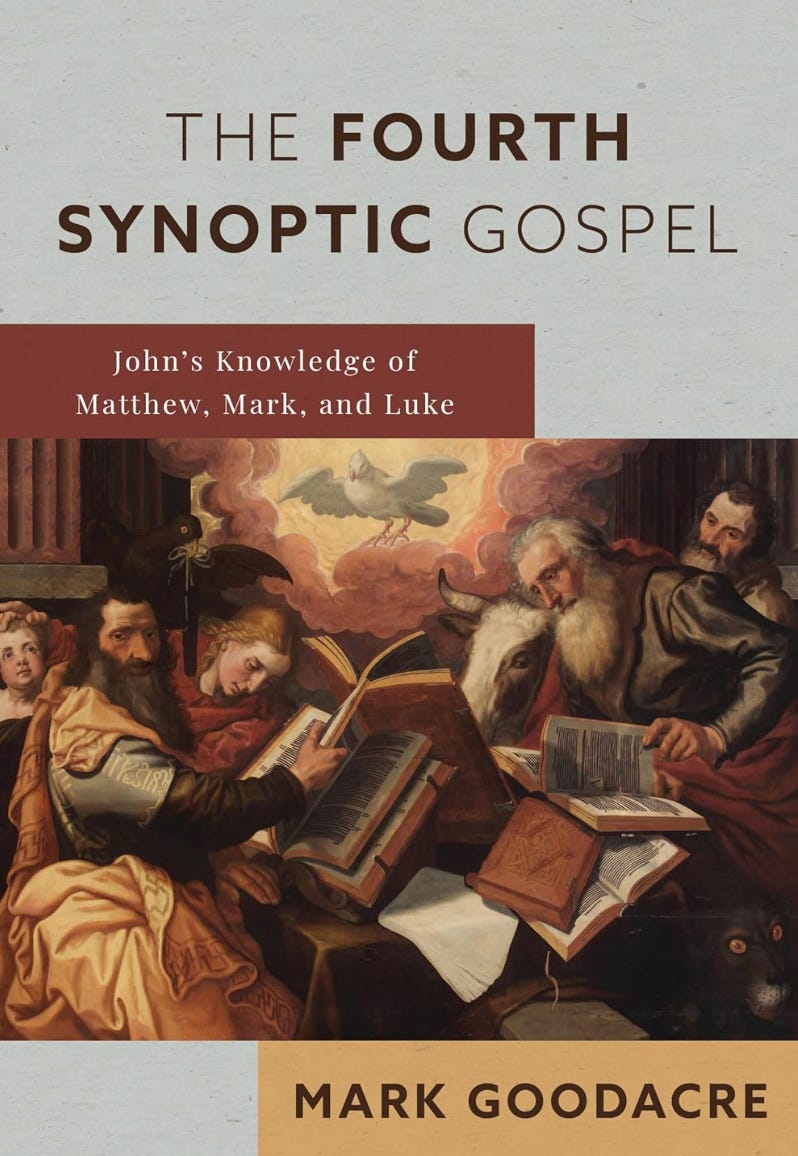
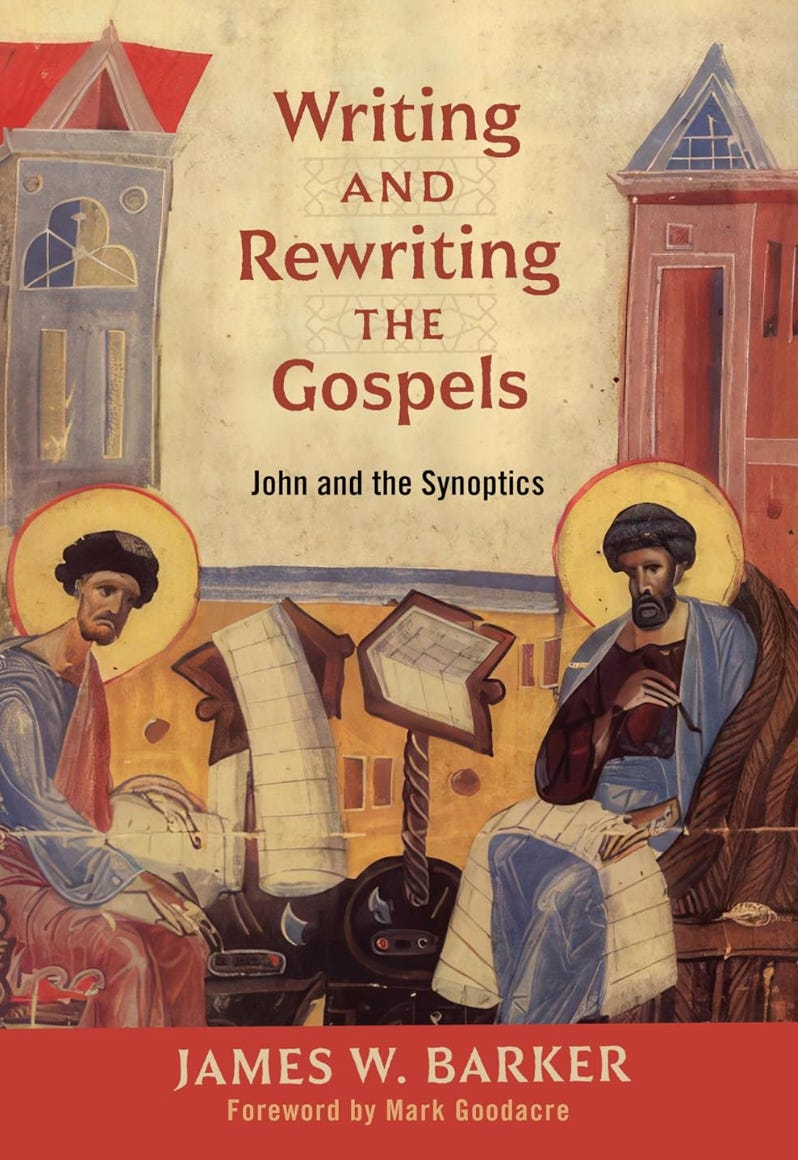
Some won’t let this go so easily. Two books have arrived on my doorstep in the last month that belong to a steady stream of scholars who think we ought to be rethinking the relationship of GJohn to the Synoptics. The claim is that they are not independent; GJohn knew the Synoptics. The two books, in the order of their arrival, are James W. Barker, Writing and Rewriting the Gospels: John and the Synoptics, and Mark Goodacre, The Fourth Synoptic Gospel: John’s Knowledge of Matthew, Mark, and Luke. Both are published by Wm. B. Eerdmans. Both are well-written; they are not making the same case.
Barker thinks the Gospel “tradition” if one wants to call it that snowballed from the GMark to the GMatthew to the GLuke to the GJohn, each reworking, reimagining, and transforming the one before them. Thus, there is lots of copying and correcting and reshaping and revising of what was before an Evangelist.
When we talk of “dependence” or “tradition,” as those terms are often used, we go wrong when it comes to the GJohn. If how the GJohn used the OT is any standard, then rewriting and paraphrasing are marching orders for John’s Gospel. Which could mean the entire project of comparison needs a different set of categories – and that’s what both Barker and Goodacre offer us. These are new days.
Christopher Skinner, a good John scholar, says Barker’s book is a “game-changer.”
Of Goodacre’s book Skinner says Goodacre’s book “will change the field” and that he “cannot recommend it highly enough.”
Let me say, a totally respectful way, that I don’t care if Baker and Goodacre are right. What I mean is that I’m totally open to this approach. I have favored the Synoptics. GJohn scholarship is so intense it’s intimidating in scope and depth and breadth. But if John used the Synoptics, we ought to admit it and our work assuming that view.
As a non scholar, I always assumed the GJohn was written with the knowledge of the other three so he felt there were things he didn't need to repeat.
Thank you Scott