
This is a Jesus Book

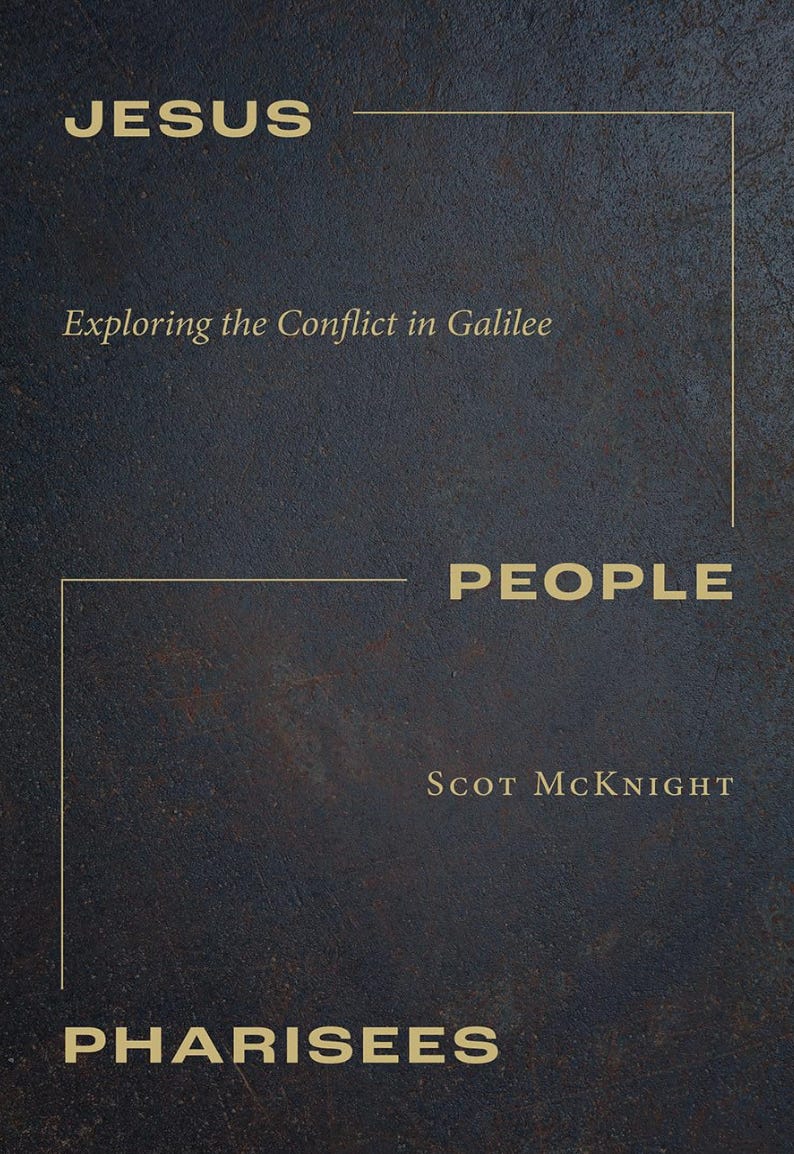
From Jesus, People, Pharisees (Fortress, 4 August 2026).
This is a Jesus book. I did not expect or anticipate writing another Jesus book and had sworn off engaging in the historical Jesus enterprise because I did not believe historical Jesus scholars could ever reach anything like a consensus on what counts as authentic or what does not. I remain stubbornly committed to studying Jesus while avoiding the traditional methods designed to lead us back to the historical Jesus with a kind of scientific accuracy. So, I have raised my hand one more time to write about Jesus. I do so only because I have become unnerved about how Christians write and especially preach about the Pharisees. When I read a wonderful recent volume about the Pharisees (edited by Joseph Sievers and Amy-Jill Levine) I could not put the book on the shelf without committing myself to explaining how Jesus related to the Pharisees, or how the Pharisees related to Jesus. Hence, this book.
Jesus, People, Pharisees attempts to put the Pharisees and Jesus into a credible first-century story about Jesus in the context of the Roman occupation of Judea and Galilee. That story includes the people, the populace, the hoi polloi of Galilee especially. “History,” one of my favorite American historians, Jill Lepore, writes, “is the art of making an argument about the past by telling a story accountable to evidence. In the writing of history, a story without an argument fades into antiquarianism; an argument without a story risks pedantry.” Two poles matter here: “an argument about the past . . . accountable to evidence” and “by telling a story.” The story here is what got Jesus crucified and what part the Pharisees and the crowds around Jesus played in that story. The evidence is the Gospels of the New Testament, with more attention to the Synoptic Gospels. Recent studies that delve into the Jesus of history have turned to memory theory, and there is much to learn from those studies and that theory. I follow the leads of James D. G. Dunn, my Doktorvater, and Dale C. Allison Jr., both of whom use memory theory to get back to Jesus. Each of them concentrate, in their own ways, on the gist of the evidence rather than the authenticity of a given saying or action of Jesus. There will be no attempt in this book to prove that Jesus said this or did that.
A neglected element in Jesus books has been the people, the crowds around Jesus. I will tell a story about Jesus and the Pharisees that factors in the people. What matters to me most is if the story makes sense of the course of the events that ended on or a day after Passover to kick off the third decade of the first century. Another historian, also from American history, describes what I have attempted to do:
The writing of history thus requires not just the historical actuary, who reconstructs the details of past events, but also the storyteller, who gives us a sense of their momentousness and puts it all in perspective. This task to weave a coherent story out of the tangled web of history, however, is fraught with serious danger. At best it yields a feat of the historical imagination steeped in a profound knowledge of the past. At worst, the historian becomes complicit in the narrative justification of the dominant socioeconomic order and distribution of power. . . . The saving grace is the historian’s own pesky antinomian mood and inclination.
Thus, every Jesus book is a memoir. Though some are unabashed autobiographies, nearly all of them do their best to imagine their way back to Jesus in his Galilean contexts. Moments in the accounts pull down the mask. More often the mask hides the memoir. Because of the mask, most of us aren’t aware where the account is memoir. This book is no different.
I dedicate this book to two friends, both good historians and storytellers, Joel Willitts and Mike Bird. Joel was my colleague for a decade. More than that, he has been a good friend in spite of his being a Yankee fan. I first “met” Mike Bird when I was invited to be a second reader for his PhD thesis. We met not long after and we have enjoyed two decades of friendship. He has been a good friend in spite of his disgust with a drink called coffee. Both Mike and Joel, over the gestation of this book, have received messages from me inviting their feedback, which has filtered into this book in more ways than they (or I) will ever know.
Looking forward tthis!
Sounds good, Scot! I like the way, in this post, that your description of your hope forcthe book has a lot to do with how you live, and how relatable that can be to our understanding of Jesus. I will be reading it. Thank you!